
Written by
The gecco team
Anthropic launched Claude Design. One AI platform now handles text, code, knowledge work, and visual design. Here is what changed and how to start using it.

Anthropic released Claude Design on Friday 17 April 2026. It is a new product that lets anyone create prototypes, presentations, mockups, and marketing visuals by talking to Claude.
The tool is powered by Claude Opus 4.7. It is available in research preview for Pro, Max, Team, and Enterprise subscribers. Enterprise plans have it turned off by default.
Claude Design lives at claude.ai/design. You describe what you want. Claude builds it on a canvas. You refine through chat, inline comments, or direct edits. The output is functional code, not a static image.
The product covers six categories of visual work. Realistic prototypes. Wireframes and mockups. Design explorations. Pitch decks. Marketing collateral. Code-powered prototypes.
You start by creating a project and adding context. Screenshots, existing design files, or a linked codebase all work. Describe what you want in the chat panel. Claude generates a working design on the canvas.
Iteration happens through two channels. Chat handles broad changes like layout restructuring or colour shifts. Inline comments handle targeted fixes like button padding or font sizing.
Export options include PDF, PPTX, standalone HTML, and Canva. Completed designs can also be handed off to Claude Code as a development bundle.
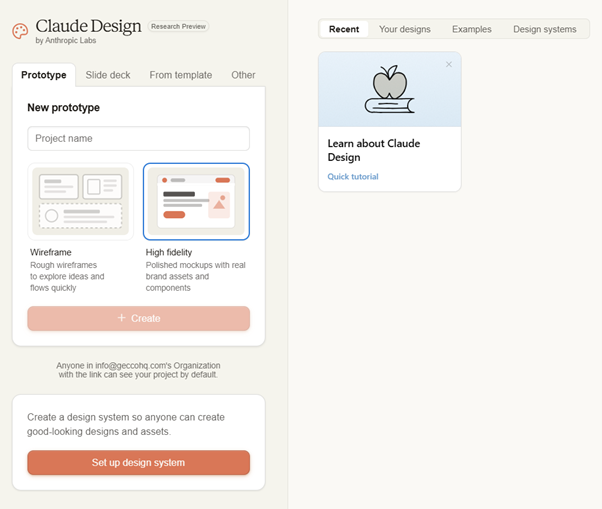
The feature with the biggest business value is design system enforcement. Teams upload their brand assets. That could be a codebase, a slide deck, a PDF brand guide, or a well-designed document. Claude analyses everything and extracts a reusable system of colours, typography, components, and layout patterns.
Once published, every project created by any team member automatically uses that system. A sales manager creating a pitch deck gets the same brand-consistent output as a marketing coordinator building a one-pager.
For UK SMEs without in-house design teams, this solves a real problem. Brand consistency has always required either a designer reviewing every output or rigid templates that limit creativity. Claude Design sits between those two options. It enforces the brand while giving people freedom within it.
Step back from Claude Design for a moment. Look at what a single Claude subscription now includes. Claude Code for development. Cowork for knowledge work. Chat for writing and analysis. Now Claude Design for visual work.
That is prototyping, coding, document creation, research, and design from one platform. One login. One data policy. One training programme for your team. One compliance framework to manage.
Compare that to the alternative. A business might use ChatGPT for copywriting, Canva for design, and a separate tool for presentations. Then add a code assistant and a research tool on top. Five tools means five subscriptions, five data handling policies, five learning curves, and five security reviews.
For a 30-person business, consolidating onto one capable platform is not just cheaper. It is easier to train, easier to govern, and easier to support.
Anthropic told TechCrunch that Claude Design complements Canva rather than replacing it. That is probably true today. But the pattern across AI is clear. Platforms get wider. Features get deeper. The gap between the AI version and the specialist tool narrows over time. If you work in the design platform industry, that trajectory is worth watching.
Claude Design does not generate images. It does not produce photographs, illustrations, or raster graphics. That gap between Claude and ChatGPT remains. ChatGPT generates images through DALL-E and GPT Image. Google offers image generation through Gemini. Claude still has no equivalent.
What Claude Design produces is functional, interactive output built as real code. A prototype is HTML, CSS, and React. You can click through it, test interactions, and hand it to a developer. That is a different category from image generation.
The tool is also web-only. It runs at claude.ai/design. It is not in the Claude desktop app, Claude Code, or mobile. The handoff to Claude Code works in one direction only. Design to code, not code to design.
Two things matter more than anything else right now.
Get your brand assets into Claude Design. Gather your brand guidelines, logo files, colour palette, and typography specs. A slide deck or document that captures your visual identity also works. Upload these and let Claude build your design system from scratch. The process takes about 10 minutes. Once it is set up, every project your team creates will match the brand automatically.
Start using it. Today. The best way to learn any AI tool is not to read about it. It is to open it, try something, get it wrong, and try again. Create a one-page project summary. Or a landing page concept. Or a dashboard layout. It does not matter what you build first. What matters is that you start.
The people who get the most from AI are not the ones who waited for the perfect use case. They are the ones who experimented early, failed cheaply, and built their skills over time. Claude Design is new. It is rough in places. That is fine. Get in, mess around, and learn on the job.
The 80/20 principle still applies. The technology is 20% of the challenge. The other 80% is helping your people understand what these tools can do and when to use them.
Claude Design does not change that equation. It widens what one platform can do. But the skills to use it well still need building. That takes training, practice, and a culture that treats AI experimentation as normal work.
If your team is already using Claude, try Claude Design this weekend. If you are still working out where AI fits in your business, take the AI readiness assessment to see where you stand.

Eight in ten employees fear blame for AI errors, yet most UK SMEs have no AI policy to tell them who is responsible. Read why that silence creates hidden risk and what to do instead.

Shopify has launched Canvas, a conversational AI tool that lets merchants design and customise their online stores through plain-language chat. Here is what UK e-commerce teams need to know before they try it.